

Customer reviews Vs. product descriptions :what really sways buyers?
Over the past decade you’ve learned that customer reviews often act as the primary trust signal while product descriptions shape expectations; you rely on reviews for authenticity but risk being misled by misleading claims or manipulated ratings. To optimize your sales, focus on clear descriptions, verified reviews and addressing negative feedback quickly to preserve higher conversion and long-term loyalty.
Key Takeaways:
- Authenticity wins: verified customer reviews build trust and reduce perceived risk more than polished descriptions.
- Product descriptions set expectations and address objections with specifications, benefits, and search-optimized keywords.
- Volume, recency, and user-generated photos in reviews strongly influence perceived reliability and purchase intent.
- Balanced negative feedback can increase credibility when paired with thoughtful seller responses; perfect ratings may breed skepticism.
- Optimal results combine clear, accurate descriptions for discovery with prominent, up-to-date reviews to close the sale.
The Role of Product Descriptions
Purpose and types: informational, persuasive, technical and storytelling descriptions
You rely on descriptions to answer immediate questions: what the product is, who it's for, and whether it solves a problem. Informational descriptions deliver facts-dimensions, materials, compatibility-so the buyer can quickly verify fit; persuasive descriptions focus on benefits and outcomes, often boosting conversions by an estimated 10-30% in A/B tests when paired with strong social proof. Technical descriptions supply precise specs and tolerances for engineers or hobbyists, while storytelling descriptions build brand affinity by placing the product in a relatable context or scenario.
- Informational - fast facts, measurements, materials.
- Persuasive - benefit-led copy, value propositions, CTAs.
- Technical - specs, tolerances, compatibility tables.
- Storytelling - use-cases, lifestyle framing, brand narrative.
- Hybrid - combines the above to serve multiple buyer intents.
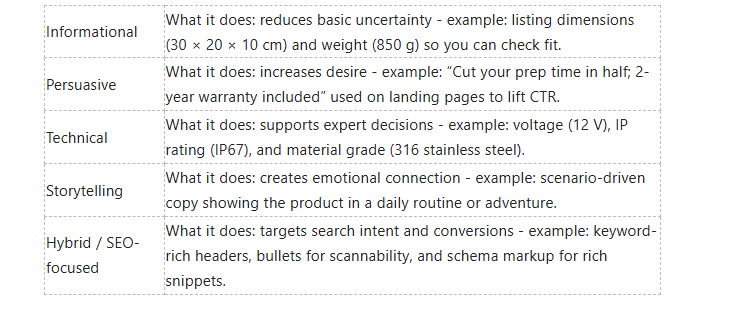
Knowing how to mix these types lets you tailor descriptions to different pages: product detail pages need at least one clear informational block plus a persuasive hook for conversions.
Key quality dimensions: clarity, accuracy, completeness, readability and SEO
Clarity means your copy can be scanned in 5-10 seconds; use bullets, short sentences, and headings so you answer the top three buyer questions immediately. Accuracy prevents returns and complaints: false or exaggerated claims increase complaints and can trigger platform penalties, so include verifiable specs and tests where possible. Completeness covers the crucials buyers need-dimensions, materials, warranty, and compatibility-and you should aim to cover all high-impact attributes for the category (typically 5-8 key fields on detail pages).
Readability ties directly to conversion: aim for a Flesch-Kincaid grade level of around 6-8 and a Flesch Reading Ease score of 60-80 for broad consumer products so you don’t lose buyers to dense technical prose. On the SEO side, keep meta titles under 60 characters, meta descriptions under 155-160 characters, use one primary keyword plus two supporting phrases, and implement schema.org/Product markup to improve the chance of rich snippets.
More specifically, you should A/B test headline variants and bullet counts: many merchants find 3-5 benefit bullets with 6-10 feature bullets yield the best balance of persuasion and scannability, and tracking conversion lifts of 10-25% after copy optimization is common.
How descriptions set expectations, reduce perceived risk and guide use
Descriptions set expectations by specifying deliverables and limits: list exact dimensions, lead times (e.g., “ships in 1 business day”), battery life (e.g., “up to 12 hours”), and included accessories so buyers aren’t surprised at delivery. That transparency reduces perceived risk because you remove ambiguity-when you clearly state what’s included and what’s not, buyers make informed choices and return rates tied to mismatch decline. Use-case examples and before/after scenarios help buyers visualize outcomes and align product choice with need.
Guiding use minimizes misuse and post-purchase friction: include setup time (e.g., “assembly in 10 minutes”), maintenance steps, and safety notes (for example, do not expose to water or contains small parts - choking hazard). Clear care instructions and compatibility lists reduce support tickets and improve first-use satisfaction, so you cut friction for the buyer and for your service team.
More detail: apply progressive disclosure-start with a short summary and bullets, then expand into a technical tab or downloadable PDF-so you meet both quick-scanning shoppers and detail-seekers; adding a short FAQ addressing top 3 objections (returns, compatibility, warranty) often lowers cart abandonment and support volume.
The Influence of Customer Reviews
Social proof and credibility: ratings, averages and aggregate signals
When you scan a product listing the first things you register are the star average and the review count - those two numbers often decide whether you keep shopping or click away. For example, academic work has shown big business impacts from ratings: a one-star increase on Yelp corresponds to about a 5-9% lift in revenue for restaurants (Luca, 2011), and the same logic applies across categories where higher averages and large review volumes signal lower purchase risk.
Platforms amplify different aggregate signals - average, median, rating histogram, percentage of 4-5 star reviews - and you should read them together. A product with a 4.6 average from 2,500 reviews gives you more confidence than a 4.8 from six reviews; meanwhile a long tail of 1-star complaints in the histogram often outweighs a high mean because it signals consistent failure modes. Pay attention to whether the site uses recency-weighted averages or filters out suspected fake reviews, since those algorithms materially change what the average actually means.
Review content features: recency, length, specificity, images and videos
Recency is one of the fastest signals you use: a 4‑star review written three days ago feels more relevant than a 5‑star from three years back, especially for electronics or fast-moving categories. You also gravitate toward reviews that give measurable details - dimensions, battery life in hours, or a concrete use case - because specificity reduces uncertainty; short, generic praise ("great product") carries much less persuasive weight than a 70-120 word account that lists pros, cons and a photo of the product in use.
Visual content changes the game: reviews with photos and short videos surface usability, fit and real-world finish in ways text cannot, and many merchants report higher click-through and lower return rates when UGC media is abundant. Sites that surface photo-first galleries or auto-play short review clips effectively shorten your decision time because you can validate look-and-feel instantly without parsing paragraphs of text.
To act on this, you should prioritize recent, specific, media-rich reviews when evaluating a product: look for timestamps within the last 30-90 days, seek comments that include at least one concrete metric or scenario, and give extra weight to reviews that include photos or a 10-30 second demonstration video - those are the ones most likely to predict real-world satisfaction and reduce post-purchase friction.
Reviewer signals: verified purchase, reviewer reputation, volume and distribution
You habitually trust badges and provenance: a verified purchase tag or a reviewer marked as a long-time contributor signals that the reviewer actually used the product rather than just reacting to marketing. Platforms like Amazon, TripAdvisor and Yelp make those cues visible; you should mentally upweight ratings from users with extensive histories or platform-recognized status (Top Reviewer, Elite, Vine member) because their track records reduce the chance of spam or incentivized bias.
Volume and distribution of reviews together tell you whether the average is stable or fragile: thousands of reviews smooth out variance while a bimodal distribution - lots of 5‑stars and a cluster of 1‑stars - indicates polarized experiences that require closer reading. Also watch for timing: sudden bursts of hundreds of 5‑star reviews in a 24-48 hour window are a red flag for coordinated manipulation, while steady review velocity over months suggests organic demand and reliable quality.
When you evaluate reviewer signals more deeply, check the ratio of verified to unverified reviews, inspect reviewer profiles for prior activity, and scan timestamps for review surges; a safe heuristic is that a healthy product will show a mix of short-term and long-term feedback, with at least several dozen verified reviews spread over multiple weeks rather than concentrated in an unexplained spike - deviations from that pattern often point to fake reviews or temporary promotions that will bias your impression.
Direct Comparison: When Descriptions or Reviews Sway Buyers
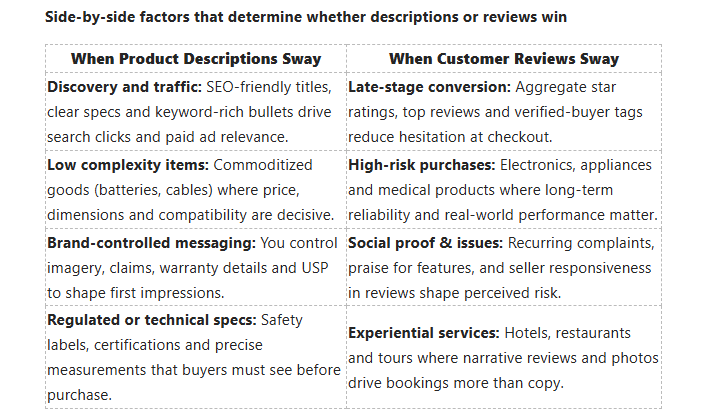
Decision stage impact: discovery, evaluation and purchase moments
At discovery, your product descriptions act as the frontline: titles, tags and concise specs determine whether shoppers find your page via search or category browsing, and well-crafted bullets can improve click-through rates from organic listings and ads. Studies commonly show that 70-90% of online shoppers consult reviews at some point, but early-stage discovery still depends on clear, keyword-optimized descriptions that match intent.
During evaluation you and your competitors both benefit from a mix: descriptions provide apples‑to‑apples comparisons (dimensions, battery life, ingredients) while reviews supply context - real-world use, durability, and edge cases. At the purchase moment, summary signals like star ratings and top pros/cons often tip the balance; A/B tests in retail environments routinely report single-digit to low‑teens percentage lifts in conversion when prominent review snippets are shown alongside specs.
Product risk and complexity: low‑involvement vs high‑involvement purchases
For low‑involvement, low‑risk items you sell to repeat buyers (household supplies, single‑use accessories), descriptions typically dominate because shoppers want quick confirmation of fit and price - your clear size, compatibility and price details will win more purchases than a long review thread. In those cases, concise specs and competitive pricing drive impulse and routine buys, while reviews often play a supporting role to filter out obvious defects.
High‑involvement purchases shift the power to reviews: when a buyer faces complexity, long-term cost or safety concerns (smartphones, mattresses, HVAC systems), detailed user feedback, failure rates and long‑term impressions carry extra weight. You will see that peer stories about reliability or hidden costs can outweigh polished marketing copy, and extended reviews or video testimonials frequently become decisive evidence.
Additional nuance: when you sell high‑risk items, make warranty terms, third‑party test results and manufacturer transparency front-and-center in descriptions while surfacing long-form reviews that address longevity and support - combining authoritative specs with corroborating reviews reduces perceived risk and increases conversions.
Category differences: commoditized goods, branded products and experiential services
Commoditized goods favor descriptions: shoppers primarily compare price, dimensions and specs, so your structured descriptions, clear imagery and availability info drive conversions; reviews mainly confirm there are no deal‑breaking defects. Branded products create a different dynamic - your storytelling, trust marks and curated benefits in descriptions influence initial interest, but reviews reveal consistency: whether your brand delivers on promised durability, fit and customer support.
Experiential services (hotels, salons, tours) are review‑centric: travelers and consumers rely on narrative detail, photos and reviewer credibility when outcomes vary widely. Platforms like TripAdvisor and Yelp demonstrate that review sentiment and recency strongly correlate with bookings, because descriptions can’t fully convey variable service quality or staff behavior.
For your product mix, segmenting by category matters: prioritize crisp, structured descriptions and spec sheets for commodities; lead with branded storytelling plus curated case studies for higher-margin branded goods; and for services, highlight recent, detailed reviews and rapid responses to complaints - matching format to category maximizes the influence of the dominant signal.
Psychological and Behavioral Mechanisms
Cognitive heuristics and biases: authority, consensus, anchoring and confirmation
You lean on authority cues and consensus because they save mental effort: a review from a recognized expert or a product endorsed by an influencer functions as an authority shortcut, and high star ratings act as a visible signal that many others approve. More than 80% of shoppers check ratings or reviews before buying, so when you display expert quotes, verified badges, or press mentions, you convert uncertainty into perceived reliability instantly.
Anchoring shifts the baseline for how you judge price and value - a crossed-out MSRP or an initial high list price anchors expectations so discounts feel larger. Tversky and Kahneman’s anchoring research explains why a $199 anchor makes $129 seem like a bargain. Confirmation bias then filters the reviews you read: you naturally scan for posts that match your prior belief about the product, which is why negative reviews can carry outsized, lasting impact and why paid or fake reviews are a direct threat to conversion rates.
Emotional drivers and narratives: trust, fear of loss, empathy and story resonance

You respond more to lived experience than to product specs: narrative reviews that describe how a product solved a concrete problem create empathy and make benefits tangible. User-generated photos and videos often outperform dry descriptions - A/B tests from many retailers show double-digit lifts in conversion when reviews include UGC, because they reduce abstraction and build trust faster than any feature list.
Fear of loss and social proof work together to push action: seeing “only 3 left” plus multiple recent purchases in reviews triggers urgency, while empathetic stories reassure you that the product fits real-life needs. When brands reply empathetically to complaints or highlight successful use cases, you’re more likely to trust the offering again; conversely, unresolved negative reviews amplify doubt and can depress demand across the category.
To leverage these emotional levers you should prompt reviewers for context (who they are, how they used the product, before/after outcomes), display verified purchase markers prominently, and use scarcity sparingly to avoid eroding long-term trust - fake or paid reviews are the most dangerous factor here because they destroy the narrative authenticity that drives repeat purchases.
Practical Strategies for Merchants and Marketers
Crafting effective descriptions: templates, spec sheets, benefit framing and sensory language
Adopt a compact template you can reuse: a one-line headline that states the primary benefit, a three-bullet spec strip (dimensions, weight, compatibility) and a two-sentence use-case that translates specs into outcomes. For example, instead of “1800W motor,” write “1800W motor - heats bread in under 90 seconds for consistently crisp results.” Include a downloadable spec sheet for high-consideration items so you reduce returns; A/B tests frequently show a 10-30% conversion lift when shoppers find clear, measurable specs up front.
Use sensory language selectively: words like “velvety,” “firm grip,” or “bright citrus notes” increase mental simulation and purchase intent, but pair them with objective data to avoid disputes. Present compatibility and warranty details in a scannable table and add icons for battery life, IP rating or weight. Also test microcopy that reframes negatives as trade-offs-“compact size for small kitchens” vs. omitting the dimension-to help the right customers self-select and lower return rates by an estimated 15-25%.
Soliciting, managing and amplifying reviews: collection strategies, moderation and response
Time your asks: send the first review request 3-7 days after delivery for fast-use products and 14-30 days for long-term items, then follow up once if there’s no response. Mix channels-post-purchase email, short SMS with a 1-click review link and an in-app prompt-to boost response rates; brands that add SMS commonly see a 20-40% increase in review volume. Offer incentives only with full disclosure and avoid pay-for-positive models; incentivized reviews must be transparent to stay compliant with platform and FTC rules.
Moderate with a hybrid approach: combine automated filters (spam, repeat reviewers, suspicious IPs) with human audits for edge cases, and respond publicly to every negative review within 48 hours with a personalized remedy offer. Use templated reply frameworks-acknowledge, explain, offer next step-but always add a unique detail so the reply feels authentic. If you remove or hide legitimate negative reviews, you risk violating platform policies and eroding customer trust, so document moderation decisions and escalate appeals.
Automate collection workflows but track the metrics that matter: review submission rate, percentage with photos, average rating by cohort and conversion lift for reviewed SKUs. Do not gate reviews (only asking vetted customers) if it filters out dissatisfied voices-platforms increasingly penalize review-gating-so rely on post-delivery prompts and frictionless media uploads instead.
Integrating descriptions and reviews: page layout, metadata, microcopy and cross‑referencing
Place the most persuasive social proof where purchase decisions happen: star rating and the top 2-3 helpful reviews should sit adjacent to price and the CTA, while a sticky spec bar follows the user as they scroll. Use tabs or anchored sections for Description → Specs → Reviews, and surface review highlights inside the description: pull a short customer quote (“kept its shape after 50 washes”) into the product summary to tie real-world outcomes to claims. Implement Product and Review JSON‑LD schema so search engines can display rich snippets-sites report CTR gains up to 30% after adding accurate structured data.
Optimize microcopy to guide behavior: buttons like “See how customers use this” that jump to photo reviews increase engagement with user-generated content, and metadata (Open Graph, Twitter cards) that includes a representative review line improves social share performance. Cross-reference by tagging reviews with product attributes (size, color, use-case) so users can filter to the exact context; for mobile, surface a one-line sentiment summary based on recent reviews (“90% recommend for camping”) to speed decisions.
Technically, load reviews asynchronously to avoid slowing page load and ensure your schema mirrors visible counts and ratings exactly-mismatches can cause search penalties. Run A/B tests on layout (sticky spec bar vs. inline specs), track downstream metrics and keep canonicalized description variants to prevent duplicate-content SEO issues; accurate structured data and synchronized visible content are the elements that protect both search visibility and customer trust.
Measurement, Testing and Optimization
Key metrics to evaluate influence: conversion lift, time on page, review elasticity and return rate
You measure influence by tying changes in copy or reviews to hard outcomes: conversion lift (add-to-cart or purchase rate), average time on page for product detail pages, review elasticity (the percent change in conversion per unit change in average rating or review volume), and return rate by SKU. Industry A/Bs typically report conversion lifts in the range of 5-15% when strong social proof (verified reviews + photos) is introduced, while rich product descriptions tend to produce smaller, steadier lifts of 2-6% depending on category.
You also track leading indicators: click-to-review interactions, scroll depth past the description, and the share of purchase-eligible sessions that view reviews. For review elasticity, benchmark by cohort: for many apparel tests a 0.5‑star improvement corresponded to roughly a 4-8% uplift in conversion, whereas in electronics the same rating change often yields a smaller uplift but a larger impact on post‑purchase returns. Use SKU-level return rates over a 30-90 day window to see whether descriptive clarity or review detail reduces returns.
Experimental approaches: A/B testing, multivariate experiments and causal attribution
Run randomized A/B tests for single changes (adding top-line review summary, changing hero description) and use multivariate or factorial designs when you want to test combinations (headline × bullet list × review snippet). Aim for a minimum detectable effect (MDE) aligned with business value-commonly 3-5% relative lift-and compute sample size ahead of launch; for low baseline conversions (1-3%) this frequently means tens to hundreds of thousands of sessions per variation. Manage seasonality with parallel holdouts and avoid sequential peeking unless you adopt proper alpha-spending rules or Bayesian stopping.
For causal attribution, pair experiments with uplift modeling and difference‑in‑differences when full randomization isn’t feasible. If you can’t randomize at the user level, instrument quasi‑experimental methods (propensity score matching, synthetic controls) and validate with back‑tests. Keep in mind that statistical significance without practical significance is misleading-report both p-values and absolute effect sizes, plus projected revenue or margin impact.
In one practical workflow you might run a three-arm A/B test: control, enhanced description, and reviews-first layout, then follow with a fractional factorial to iterate copy variants that drove the largest lift. Use multi-armed bandits only when you prioritize cumulative reward during long rollouts; otherwise stick to fixed-sample RCTs for clean causal estimates.
Data sources and analytics: qualitative feedback, clickstream and cohort analysis
Combine qualitative signals (post-purchase surveys, review text themes, customer service transcripts) with quantitative clickstream events (view-to-click, scroll depth, time to first review click) to form a layered view. You’ll want NLP topic extraction on review text to quantify common friction points-fit, durability, assembly-and map those themes back to conversion and return cohorts. In practice, text analysis often shows a handful of themes (top 3) driving the majority of negative outcomes; focus remediation on those.
Use cohort analysis to measure persistent effects: track cohorts exposed to a content change for 4, 8 and 12 weeks to see impacts on repurchase, lifetime value, and return rates. Instrument SKU-level joins so you can attribute return lift to specific pages; for example, split cohorts by exposure to revised sizing copy versus exposure to review photos and compare 90‑day return differentials. Visualize funnels by cohort and channel to spot whether review visibility helps organic traffic more than paid.
Operationally, you’ll integrate event data (GA4/Server-side), backend orders, and review databases into a warehouse (Snowflake/BigQuery) and run join queries that tie impression IDs to purchases and returns. Track a short validation window (2-4 weeks) for conversion signals and a longer window (30-90 days) for returns and LTV, and always pre-register your hypothesis, metrics, and analysis plan so your causal claims remain defensible.
To wrap up
With this in mind, you should treat product descriptions and customer reviews as complementary tools: descriptions set expectations by clearly communicating features, benefits and limitations, while reviews provide social proof, real-world context and trust signals that often tip hesitant shoppers toward a purchase.
You can maximize impact by making your descriptions accurate and scannable, encouraging verified reviews, highlighting representative positive and negative feedback, and responding to concerns-this combination helps your audience reduce uncertainty, align expectations and increase conversions.
FAQ
Q: What generally influences buyers more: customer reviews or product descriptions?
A: Both influence buyers but in different ways. Product descriptions provide factual information-specifications, dimensions, materials and use cases-that help shoppers determine fit and functionality. Customer reviews supply social proof, real-world performance, and emotional signals like satisfaction or disappointment. For routine, low-risk purchases consumers may rely more on reviews and ratings; for technical or high-investment purchases they often weigh detailed descriptions heavily before consulting reviews for validation.
Q: In which situations do product descriptions sway buyers more than reviews?
A: Product descriptions dominate when accuracy and specifics are decisive: technical equipment, medical devices, industrial components, or items requiring particular dimensions or compatibilities. They also matter for new product launches with few reviews, for regulated goods where compliance matters, and for shoppers who prioritize objective benchmarks. High-quality, transparent descriptions that answer common technical questions reduce uncertainty and can convert buyers who need concrete evidence of suitability.
Q: How do customer reviews influence purchasing decisions beyond the star rating?
A: Reviews influence through volume, recency, reviewer credibility (verified purchases, reviewer profiles), and qualitative details like photos, videos and problem-resolution stories. Pattern recognition is powerful: recurring mentions of the same strength or flaw carry more weight than isolated comments. Negative reviews can increase trust if they are specific and balanced; company responses to complaints also affect perception. Emotional language and storytelling often shape perceived value more than numeric ratings alone.
Q: How should sellers balance descriptions and reviews to maximize conversions?
A: Use descriptions to set clear expectations-accurate specs, benefits, use scenarios and honest limitations-and optimize them for scannability with bullet points and visuals. Actively solicit authentic reviews and showcase representative testimonials (including negative-to-positive resolution cases) to build trust. Surface both types of content: pair specs with customer photos, highlight top reviews near the buy button, and maintain up-to-date content. Monitor review themes and update descriptions to address common questions or misconceptions.
Q: How can buyers combine reviews and descriptions to make better decisions?
A: Start by confirming technical needs with the product description: sizes, compatibility and warranty. Then scan reviews for consistency on performance, durability and customer service, prioritizing recent and verified reviews. Look for repeated positives or problems rather than relying on single extremes, check review photos or videos, and note seller responses to issues. If stakes are high, cross-reference multiple retailers, ask questions in Q&A sections, and verify return policies or warranties before purchasing.
This is paragraph text. Click it or hit the Manage Text button to change the font, color, size, format, and more. To set up site-wide paragraph and title styles, go to Site Theme.