

The role of authentic reviews in influencing online shoppers
It's vital that you evaluate review authenticity because authentic reviews build trust, clarify product performance, and help you make smarter purchases, while fake or manipulated reviews can mislead you and cause costly regrets. You should look for specific details, balanced pros and cons, and reviewer history to gauge reliability; platforms that surface verified-purchase feedback give you stronger signals. Using this lens lets you protect your budget and time and improves the odds of satisfied buys.
Key Takeaways:
- Authentic reviews build trust and credibility, helping shoppers assess product quality and seller reliability.
- Social proof from genuine ratings and review volume increases conversion rates and purchase confidence.
- Specific, balanced reviews set realistic expectations and reduce returns and post-purchase dissatisfaction.
- Platforms that label verified purchases and actively remove fake reviews improve shopper confidence and engagement.
- User-generated content boosts SEO and discovery; photos and video reviews increase engagement and influence decisions.
Defining Authentic Reviews
What constitutes an authentic review: criteria and indicators
You should prioritize reviews that combine transaction evidence with detailed, specific observations: a verified purchase label, clear photos or videos, mention of use-case duration (e.g., "used for six months"), and concrete measurements or comparisons. Studies and platform audits repeatedly show that reviews containing multimedia and measurable details are significantly more useful than one-line endorsements, and platforms like Amazon explicitly mark purchases to help you identify those ties between reviewer and product.
Assess the reviewer metadata as well: consistent posting history, balanced star distributions, timestamps showing organic accrual, and seller replies that engage with criticism. Unusual patterns - for example a burst of 100 five-star reviews within 24 hours or multiple reviews with near-identical wording - are red flags for manipulation, while long-term reviewer histories and varied feedback topics increase the likelihood the review is genuine.
Categories of authentic feedback: verified purchases, expert commentary, community testimonials
Verified purchases confirm you’re reading feedback from someone who bought the item; expert commentary (lab tests, methodical comparisons from outlets like Wirecutter or specialized trade reviews) brings technical rigor; and community testimonials (forum posts, subreddit threads, or platform Q&A) deliver experiential nuance and long-term usage stories. Each category answers different buyer questions: transaction credibility, performance validation, and practical fit within real-world workflows.
Practical examples show how these categories complement each other: a phone launch will get lab battery-cycle data from experts, immediate verified-buyer impressions on retail pages, and later community threads about durability after months of use. When you combine a lab score with multiple verified long-term user reports, you reduce uncertainty far more than relying on any single type of feedback.
You should weigh each type depending on product complexity: for low-cost consumables, prioritize verified purchases and repeat purchase signals; for technical purchases, give extra weight to expert commentary supplemented by verified user follow-ups; for lifestyle or fit-sensitive products, trust community testimonials that include diverse body types, settings, or routines.
Distinguishing authentic reviews from biased, incentivized, or fraudulent content
You can spot biased or incentivized content by patterns: overly generic praise without specifics, failure to disclose compensation, a cluster of five-star reviews with similar phrasing, or reviewers who only ever praise one brand. Platforms and regulators require disclosure for paid reviews, so absence of that language alongside suspicious patterns should make you skeptical of a review’s independence.
Countermeasures you can use include cross-checking reviewer profiles for history, using third-party audit tools that analyze reviewer networks, verifying presence of verified purchase tags, and reading negative or mixed reviews for detail - those often reveal trade-offs that promotional posts omit. You can also compare claims against expert test results or manufacturer specifications to see if extraordinary claims hold up.
When you investigate further, focus on the seller engagement and the content of negative feedback: a genuine ecosystem will show thoughtful seller responses, follow-up Q&A, and substantive negative reviews that describe context (e.g., "stopped working after three washes" or "battery life dropped 25% after six months"), all of which strengthen the case that overall review data is authentic.
Why Authenticity Matters: Psychology and Trust
Social proof, credibility heuristics, and the formation of consumer trust
Your decisions are guided by observable cues from other people: star ratings, review counts, and reviewer profiles act as fast shortcuts your brain uses to judge quality. Studies show this matters in dollars - a Spiegel Research Center analysis found that products with reviews can see as much as a 270% increase in conversion compared with products without reviews, and Harvard research on Yelp indicates that a one-star change can alter a business’s revenue by roughly 5-9%, illustrating how social signals translate into economic outcomes.
Your trust forms around a handful of credibility heuristics: recency, reviewer identity, specificity, and corroboration across platforms. You’re more likely to accept a review when multiple independent reviewers describe the same issue in detail, when profiles include photos or location data, and when platforms surface a verified purchase badge - these simple signals let you reduce cognitive load and decide faster without deep research.
How authentic reviews reduce perceived risk and influence confidence
You face several types of perceived risk - financial (will it be worth the money?), performance (will it work as advertised?), social (will others approve?), and privacy (is my data safe?). Authentic reviews act as risk-reduction tools by providing concrete evidence: detailed pros and cons, real-world photos, and use-case descriptions that let you predict product fit more accurately. That evidence partly explains why conversion lifts tied to reviews are so large - you’re effectively outsourcing parts of product testing to other consumers.
Mechanically, authenticity reduces ambiguity. When reviews show balanced, specific feedback and timestamps, you gain clearer expectations and therefore higher purchase confidence; sellers who surface reviewer photos, purchase verification, and seller responses typically report double-digit uplifts in engagement in A/B tests. Negative but honest reviews also lower post-purchase disappointment because they set realistic boundaries on performance and usage, decreasing returns and complaints.
For practical impact, you should treat authenticity cues as product features: display reviewer metadata, surface diverse voices (first-time buyers, repeat customers, different use cases), and highlight reviewer-generated images and video. Doing so not only increases your buyers’ immediate confidence but also builds a compounding trust asset - once your audience perceives reviews as genuine, your brand enjoys sustained higher conversion and lower refund rates over time.
How Reviews Shape the Purchase Journey
Discovery and consideration: search visibility, shopper attention, and information salience
Search engines and marketplaces surface products with higher review volume and ratings, so you see those items earlier in results - rich snippets showing an average rating often lift click-through rates by 20-30%. When you search, filters for rating, review count, and “most reviewed” steer attention; a product with 500+ reviews commands more clicks and perceived legitimacy than one with three.
Snippets and top review excerpts act like headlines: you skim the first sentence, the star average, and whether reviewers mention specific attributes like “battery life” or “fit.” Because attention is limited, salient, structured details (short pros/cons, a photo, and a verified-purchase tag) make you more likely to move a product into consideration rather than get lost in generic praise.
Evaluation and decision-making: star ratings, sentiment, pros/cons, and comparative cues
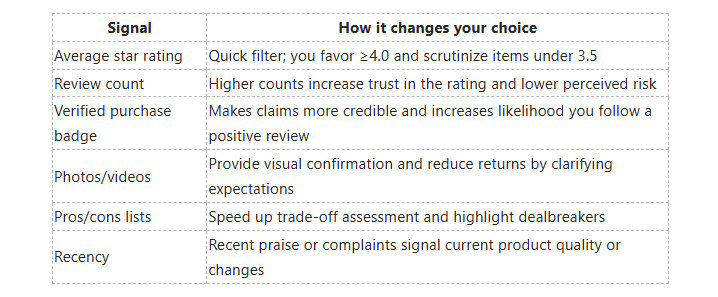
Star ratings serve as a fast heuristic: you typically filter out sub-3.5-star items and favor products at or above 4.0 stars. Negative reviews have outsized influence - a handful of consistent complaints about the same issue (for example, “stitching rips after two washes”) can reduce your purchase intent far more than an isolated, vague negative.
Sentiment analysis and explicit pros/cons lists let you parse trade-offs quickly. You pay attention to aspect-level signals (fit, durability, battery life) and comparative cues like “#1 in charging cables” or “top-rated in size L” to choose between similar options. Reviews that include measurements, photos, or use-case details make it easier for you to match product claims to your needs.
You should focus on how each review signal maps to practical risk and reward: star averages indicate general quality, review counts signal reliability of that average, and verified purchases plus photos reduce uncertainty. That mapping is what turns passive browsing into confident buying.
Evaluation signals and their effects
Post-purchase effects: returns, satisfaction signals, repeat purchase and word-of-mouth
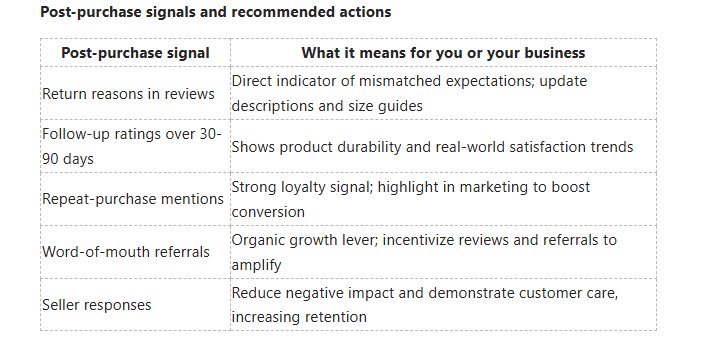
After you buy, reviews shape whether the experience gets amplified or eats margin. Detailed reviews with usage tips or sizing guidance reduce the mismatch between expectation and reality, and merchants report that clearer UGC can cut return rates significantly - in some apparel categories returns drop by up to 20-25% when reviewers include fit and dimension details. When your purchase matches the reviews, you’re more likely to leave positive feedback yourself.
Satisfaction signals in follow-up reviews and ratings influence future behavior: products that sustain an average above 4.5 stars over time often see higher repurchase and lower churn. You’re also more likely to recommend a product when a brand responds to feedback publicly; timely seller responses shift dissatisfied buyers toward retention and can convert detractors into advocates.
Use post-purchase signals to close the loop: monitor return-related complaints, surface reviewer tips in product pages, and highlight repeat-buyer comments to increase confidence and reduce friction for future shoppers.

Platform Design and Moderation
Presentation and UX: sorting, highlights, and review prominence that affect influence
You notice influence in the moment reviews are surfaced: default sorting (e.g., "most helpful" vs. "most recent") and which reviews are pinned determine the narrative. Platforms typically display the first 3-5 reviews prominently on product pages or search results, so those entries often set the tone for your buying decision.
Rich elements - aggregated star averages, review counts, image/video thumbnails and highlighted pros/cons - amplify impact by making signals scannable. For example, search results that show star ratings and review counts consistently increase click-through rates on product listings, and spotlighting recent negative feedback can drop perceived quality faster than the same number of positive reviews raises it.
Moderation and authenticity controls: algorithms, human review, verification badges, and community reporting
You see platforms combine automated detection with human oversight to keep reviews reliable: algorithmic signals (burst patterns, IP clustering, duplicate text, anomalous rating changes) triage suspicious submissions, while escalations go to trained moderators for contextual assessment. Prominent markers like the "Verified Purchase" badge and curated programs (Amazon Vine, TripAdvisor contributor tiers) are used to signal higher trust to you.
Community reporting and reviewer metadata act as crowd-sourced checks you can use to judge authenticity; however, there’s a trade-off between scale and accuracy - automated filters can catch mass fraud quickly but produce false positives, while human review is slower and costs more. Many platforms publish removal or filtering actions in transparency reports and keep appeals channels so you can see when content is disputed or restored.
Operationally, moderation pipelines often follow a three-stage flow: automated triage flags content, human teams perform context-aware review, and platforms apply actions (remove, demote, badge, or warn). You can improve your own reading by scanning for verification badges, reviewer history, and response threads - these signals indicate whether a review passed algorithmic and human scrutiny and therefore deserves more weight in your decision.
Business Practices to Encourage and Leverage Authentic Reviews
Ethical solicitation: timing, transparency, and acceptable incentives
You should time review requests to match product experience: for consumables and fast-moving goods send a prompt 3-7 days after delivery, for electronics or appliances wait 14-21 days so users have real usage to report. A/B test intervals-many merchants find a 7-14 day window maximizes response rate without prompting premature impressions.
Be explicit about incentives and follow regulatory guidance: disclose any compensation or free-product programs per FTC rules and platform terms. Acceptable approaches include small discounts on a future order, sweepstakes entry, or curated sampling programs like Amazon Vine when disclosure is clear; avoid paying for positive reviews or gating feedback, because fake or coerced reviews can lead to platform penalties and reputational damage.
Responding to reviews: complaint handling, service recovery, and public engagement
You should measure and commit to response SLAs-public replies within 24-48 hours for negative reviews and a private follow-up within 48-72 hours when resolution requires personal data. Use a three-part script: acknowledge, propose a concrete remedy (refund, replacement, troubleshooting), and invite continued dialogue offline to protect privacy; speed and specificity are what reduce escalation.
Train your agents to convert complaints into service-recovery wins: empower frontline staff with approved remedies and refund thresholds, log every resolved case, and ask satisfied customers to update their review. Companies that formalize recovery workflows often see material lifts in repeat purchase rates and net promoter scores because visible remediation signals reliability to future shoppers.
Operationalize review response by creating templated but customizable replies, routing escalation triggers (e.g., safety issues or recurring defects) directly to product and legal teams, and tracking resolution outcomes in your CRM so you can demonstrate the business impact of public engagement.
Operational use: integrating reviews into product development, merchandising, and marketing
You should treat reviews as continuous user research: implement NLP-driven topic extraction to surface the top three recurring complaints and features, then prioritize fixes when a single issue appears in a defined share of feedback (for example, when >5% of recent reviews mention the same defect). That feeds a closed-loop: issues discovered in reviews → product ticket → customer-facing update and follow-up communication.
Leverage reviews in merchandising and marketing by surfacing highest-rated variants, using verified-review snippets in ads (with explicit permission), and A/B testing review placement-brands often report conversion lifts when they show both star averages and representative quotes together. Ensure you have usage rights and adhere to truth-in-advertising rules when amplifying customer words.
Build KPIs and dashboards-review velocity, average sentiment, and defect-theme alerts-and set operational thresholds that trigger playbooks (e.g., pause a SKU if safety mentions spike). That way you convert qualitative feedback into prioritized product changes, merchandising adjustments, and measurable marketing assets.
Measuring Impact, Risks, and Regulatory Landscape
Metrics and analytics: conversion lift, review quality indices, sentiment analysis, and ROI
You should run controlled A/B tests that isolate the effect of reviews on product pages; typical tests show a 10-25% conversion lift when verified, recent reviews and star averages are displayed prominently, with some high-trust categories reporting up to 30% lift. Track both absolute and relative lifts: measure baseline conversion rate, conversion after review exposure, and incremental buyers by cohort (new vs returning customers). Segment results by review volume, average rating band (e.g., 4.0-4.5 vs 4.5-5.0), and recency to see where impact concentrates.
You can build a review quality index by weighting signals such as verified purchase flags, helpfulness votes, review length/specificity, and recency (example weights: 0.35 helpfulness, 0.30 verified, 0.20 recency, 0.15 specificity). Apply sentiment analysis and aspect-based NLP to surface issues that correlate with returns or support tickets-negative sentiment on “fit” or “battery life” often predicts higher return rates. For ROI, compute incremental revenue = traffic × baseline conversion × conversion lift × AOV, then subtract moderation, platform and fraud-detection costs; for example, 100,000 visits × 2% baseline × 15% lift × $80 AOV yields an incremental $24,000, which you then compare to your monthly moderation spend.
Legal and ethical considerations: deceptive review laws, disclosure requirements, and industry best practices
You must design systems with statutory frameworks in mind: the U.S. FTC requires clear disclosure of material connections for endorsements, the UK CMA enforces actions against fake reviews and misleading practices, and the EU’s Omnibus Directive and national regulators expect platforms to take reasonable and proportionate steps to prevent manipulated ratings. Regulators have pursued enforcement where platforms or sellers either suppressed negative reviews or failed to disclose paid or incentivized endorsements, creating both reputational harm and the risk of regulatory sanctions.
You should implement industry best practices such as marking verified purchases, logging and retaining review provenance metadata, using third‑party verification or certification (e.g., Trustpilot/Bazaarvoice-style provenance stamps), running automated fraud-detection models, and maintaining a transparent dispute and takedown process. Publishers that adopt routine audits, require explicit reviewer consent for publication, and keep an audit trail reduce legal exposure and improve consumer trust; regulators increasingly expect that level of documented diligence.
Beyond enforcement, you need to reconcile review moderation with privacy and disclosure rules: retain reviewer metadata long enough to investigate complaints while complying with GDPR/CCPA (obtain consent, honor deletion requests where required), require clear, conspicuous disclosures for any paid or incentivized review (simple labels like “#ad” are insufficient if not prominent), and prepare for cross-border variability in law-failure to do so can lead to class-action risk, regulatory fines, and loss of marketplace access.
Summing up
So you should treat authentic reviews as one of the most reliable signals when deciding what to buy online: they reduce uncertainty, reveal recurring strengths and weaknesses, and help you weigh trade-offs that product pages seldom address. By scanning patterns in rating distribution, specific pros and cons, timestamps, and user-uploaded photos or videos, you can quickly separate informed opinions from outliers.
You can also use reviews strategically: filter for verified purchases, prioritize recent and detailed experiences, and watch how brands respond to criticism-responses often indicate whether a seller values long-term satisfaction or short-term sales. When you rely on genuine consumer feedback, you make better purchasing choices and compel sellers to improve quality and transparency.
FAQ
Q: What are authentic reviews and why do they matter to online shoppers?
A: Authentic reviews are unprompted evaluations from real customers that reflect genuine experiences with a product or service. They matter because they provide social proof, reveal real-world product performance, highlight common pros and cons, and help shoppers form realistic expectations before buying.
Q: How do authentic reviews influence purchase decisions and conversion rates?
A: Authentic reviews build trust and reduce perceived risk, which shortens the decision process and increases conversions. Shoppers rely on peer opinions to validate claims, compare alternatives, and decide on price value; a mix of positive and critical feedback often improves credibility and persuades more confident purchases.
Q: What effects do fake or manipulated reviews have on shoppers and marketplaces?
A: Fake reviews distort product quality signals, lead to poor buying outcomes, erode consumer trust in sellers and platforms, and can cause higher return rates and negative word-of-mouth. Marketplaces face reputational damage and regulatory exposure if manipulation becomes widespread, prompting tighter enforcement and algorithm adjustments.
Q: How can shoppers spot authentic reviews among many entries?
A: Check for verified-purchase labels, reviewer history and profile depth, specific details about use cases, consistency in language across multiple reviews, inclusion of photos or videos, balanced praise and criticism, and realistic timing patterns rather than large bursts of similar ratings.
Q: What should businesses do to encourage and leverage authentic customer reviews?
A: Ask for feedback at the right moment after delivery, make it easy to leave reviews across devices, encourage media-rich submissions (photos, videos), respond professionally to both positive and negative feedback, disclose incentives transparently, use third-party moderation or verification services, and surface authentic reviews prominently to guide buyer decisions.
This is paragraph text. Click it or hit the Manage Text button to change the font, color, size, format, and more. To set up site-wide paragraph and title styles, go to Site Theme.