
How online reviews impact brand reputation and consumer loyalty
Many of your customers rely on online reviews to judge your business, so you need to manage reviews proactively: negative reviews can quickly spread and damage trust and sales, while positive reviews build loyalty, increase conversions, and attract new customers. Your review monitoring and response strategy signals your values to prospects, and consistent, genuine engagement turns feedback into competitive advantage; ignoring reviews risks lasting reputational harm.
Key Takeaways:
- Online reviews shape first impressions, influence search visibility and click-through rates, and often determine whether consumers consider a brand.
- Consistent positive reviews build trust and reduce perceived risk, increasing conversion and repeat-purchase likelihood; negative reviews can erode trust quickly.
- Timely, personalized responses to both positive and negative reviews improve customer perception, mitigate damage, and strengthen loyalty.
- Review volume and recency amplify impact: more recent and numerous reviews carry greater weight, while low review counts make each negative review more damaging.
- Authenticity and transparency matter: verified, honest reviews and visible product/service improvements driven by feedback foster advocacy; fake or manipulated reviews harm reputation and loyalty.
The Online Review Ecosystem
Platforms and formats - overview of marketplaces, review aggregators, social channels, and common review formats (ratings, text, images, video)
On marketplaces like Amazon, eBay, Walmart you’ll see review systems tightly integrated with purchase data: star averages, verified-purchase badges, and product Q&A. Aggregators and directories such as Google Reviews, Yelp, Trustpilot, and TripAdvisor compile business-level feedback across channels and often present an overall score or trust badge that feeds into search and local discovery. Social platforms - Facebook, Instagram, TikTok, and YouTube - surface reviews as short-form video testimonials, photos, influencer posts, and comment threads that blend opinion with social proof and reach.
Common formats span a 1-5 star or thumbs scale, NPS-style 0-10 scores, free-text narratives, and multimedia attachments; many sites now require or encourage images or videos because rich media increases perceived authenticity and conversion. You’ll also encounter structured feedback like attribute ratings (shipping, value, support), verified-purchase flags, and curated “most helpful” highlights - each format changes how consumers scan and interpret sentiment when deciding whether to engage with your brand.
Review visibility and dynamics - how volume, recency, and platform algorithms determine which reviews consumers see
Volume acts as a social amplifier: a product with hundreds of reviews signals stability, while a single five-star review can feel less persuasive. Platforms weigh counts against averages and often require a minimum number of reviews before showing a prominent score, so your early-stage products suffer a visibility gap until review velocity grows. At the same time, consumers tend to favor middle-range reviews (2-4 stars) for detail, so you should monitor both quantity and the distribution of ratings, not just the mean score.
Recency matters because most platforms prioritize fresh, engaged content: search and feed algorithms boost reviews with recent activity, helpful votes, or responses. Helpful-vote systems, comment threads, and reporting flags feed into ranking signals, so a 2019 review with dozens of helpful votes can outrank a recent one that has no engagement. Algorithms also tailor what individual consumers see based on behavioral signals - previous clicks, geographic proximity, and purchase history - which means what appears in front of you isn’t the same as what appears for another user.
Digging deeper, you’ll find platform-specific mechanics: Amazon’s “Top reviews” blend verified-purchase status and helpful votes; Yelp uses a proprietary “Recommend” filter to suppress low-quality or solicited reviews; Google’s local pack favors businesses with steady incoming reviews and higher recency. These operational differences mean your reputation strategy must target the right signal for each channel - volume on marketplaces, recency on local search, and engagement on social.
Authenticity and trust signals - verified-purchase tags, reviewer profiles, moderation, and mechanisms to detect fake or biased reviews
Verified-purchase badges and detailed reviewer profiles are prime trust levers you’ll rely on: a verified-purchase tag signals a direct transaction tie and typically increases consumer trust substantially. Platforms combine visible indicators (purchase verification, reviewer history, photos uploaded) with moderation metadata (removed, reported, or promoted) so you can assess the provenance of a review quickly. When reviewers have long histories and consistent activity, their opinions carry more weight for shoppers and for the platform’s ranking logic.
To combat manipulation, platforms use layered defenses: automated pattern detection (account clustering, IP and payment anomalies), natural language models spotting duplicated text or unnatural sentiment, and human moderation for edge cases. You’ll also see business-facing features - dispute workflows, appeal processes, and third-party verification partners - that help address incentivized or biased reviews. Regulators and industry standards push for disclosure of paid endorsements, and enforcement actions against review-fraud marketplaces have increased over the past five years, raising the cost of buying fake reviews.
On the technical side, machine-learning classifiers analyze temporal bursts, review similarity, and reviewer behavior to score suspicious activity, while manual audits and sampling validate model outputs; you should monitor flags like sudden review spikes from a single region or multiple five-star posts with identical phrasing. Responding publicly to reviews and maintaining transparent disclosure for incentivized feedback also improves your brand’s perceived trustworthiness and reduces the impact of any disputed or removed content.
How Reviews Shape Brand Reputation
Social proof and perceived quality - how positive reviews build credibility and influence public perception
Positive reviews act as social proof that your product or service meets expectations; when potential customers see multiple independent endorsements, perceived quality rises and conversion rates climb. Studies show business outcomes shift with ratings - for example, a Harvard Business School analysis found that a one-star increase on Yelp corresponded to a 5-9% revenue uplift for restaurants, illustrating how visible praise translates directly into customer behavior.
Beyond averages, volume and recency matter: you want both a high score and sustained incoming feedback, because platforms and shoppers treat a large, fresh sample as more credible. Presenting a mix of detailed testimonials and quantified ratings (star count, review totals, recent reviews) helps you dominate first impressions on search results and product pages, turning passive browsers into repeat buyers.
Trust, credibility, and brand equity - long-term reputation effects from consistent review patterns
Consistent patterns of positive reviews build brand equity by establishing expectations that stick; over months and years, a stable 4.5+ rating becomes part of your brand promise and reduces friction in the purchase funnel. You increase perceived trust when ratings are steady and responses are timely - brands that respond within 24-48 hours to reviews signal attentiveness, which studies link to higher customer retention.
When your review profile is regularly refreshed with authentic feedback, third‑party platforms begin to rank you higher and feature you more prominently, which compounds visibility and trust. You should monitor not only averages but trends: a slide from 4.6 to 4.2 over six months can indicate operational issues and corrode brand equity before your sales data reflects the decline.
Additional detail: prioritize systems that encourage verified-purchaser reviews and solicit feedback at key moments (post-delivery, after onboarding) because verified, time-stamped reviews reduce skepticism and strengthen long-term credibility, while an influx of organic reviews helps insulate your brand against isolated negative incidents.
Reputation risk and crisis amplification - how negative reviews spread, escalate, and damage brand standing
Negative reviews can travel fast across platforms and social media, and a handful of high-visibility complaints can trigger outsized reputational damage; the same algorithms that boost positive social proof also amplify contentious content, making your vulnerabilities more visible. A widely shared 1-star experience or a viral customer video can depress conversions and invite media scrutiny, turning a single complaint into a broader trust issue.
Impact magnifies when negative feedback is clustered around the same issue (delivery failures, safety, fraud), because patterns suggest systemic problems and reduce buyer confidence faster than random, isolated complaints. You must treat spikes in negative sentiment as early warning signals: rapid detection and transparent remediation reduce escalation and limit long-term damage.
More detail: implement alerting for sudden drops in average rating or surges in keyworded complaints, since speed of response and visible corrective action are the most effective mitigants-without prompt acknowledgment and fixes, negative narratives tend to persist in search results and review summaries, extending the harm to your brand.
Reviews and Consumer Decision-Making
Discovery and consideration - the role of reviews in search, product listings, and conversion funnels
You’ll see review signals - star ratings, review counts, and snippets - directly in search results and product listings, and they materially change click-through rates. For example, pages that display star ratings in Google’s rich snippets can experience as much as a 30-35% lift in CTR, sending more qualified traffic into your top-of-funnel. On marketplaces, products with >50 reviews and an average above 4.0 typically outrank similar SKUs, because platforms weight engagement and social proof in their ranking algorithms.
When users move from discovery to consideration, review density becomes a filter: high average ratings plus many recent reviews accelerate progression through the funnel, while a handful of vivid negative reviews can add friction and drop conversion. You should track not only mean rating but distribution (percent 5-star vs 1-star) and recency windows - conversion rates often correlate more strongly with reviews from the last 90 days than with lifetime averages.
Cognitive biases and heuristics - negativity bias, recency effects, and herd behavior in review interpretation
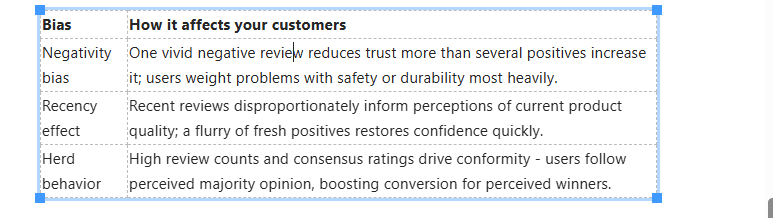
You’ll notice that a single negative review carries far more weight than individual positives: negativity bias means users give disproportionate attention to problems, especially those describing safety, durability, or ethical concerns. That explains why products with mostly 4-5 star reviews but one detailed 1-star about a safety failure can see outsized drops in conversion and returns inquiries.
Recency effects and herd behavior overlap to create momentum: recent positive reviews signal current quality, and higher visible volumes produce a conformity effect where users infer consensus and follow it. Consequently, a sequence of positive recent reviews can restore trust faster than fixing old, low-rating records buried in your history.
Key danger: if negative anecdotes mention safety, fraud, or health, they will amplify due to bias and spread rapidly; you must surface and address those quickly to prevent cascading drops in purchase intent.
Biases and Consumer Effects
Price perception and value judgments - how reviews alter willingness to pay and comparative evaluations
You’ll find that reviews shift not just whether someone buys, but how much they’ll pay: positive social proof lets you command a premium because users interpret high ratings as a signal of reliability and lower post-purchase risk. Industry analyses commonly report consumers willing to pay roughly 10-20% more for higher-rated options in crowded categories, especially services like hotels and restaurants where reviews speak to experience quality.
Conversely, visible negative feedback increases price sensitivity - customers discount perceived value and search for lower-priced alternatives or contingent guarantees. In practice, a small drop in average rating (for example 4.6 to 4.3) can shift shoppers toward lower-priced competitors or trigger demand for discounts and stronger return policies.

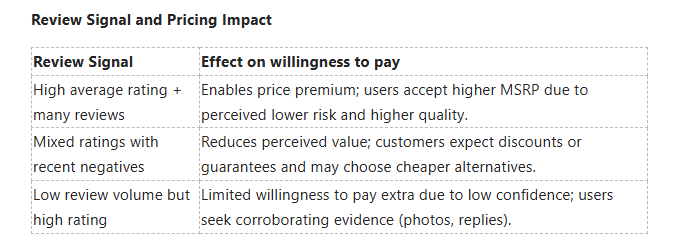
To capture value you should use reviews in pricing experiments: A/B test premium messaging on products with >100 positive reviews, and offer limited-time guarantees or price-match assurances where ratings are inconsistent to reclaim willingness to pay.
Reviews, Loyalty, and Customer Lifetime Value
Post-purchase satisfaction and retention - using reviews to measure satisfaction and reduce churn
Treat reviews as a near-real-time CSAT channel: track the rolling 30-day share of 4-5 star reviews and flag a drop below a set threshold (for example, 70%) to trigger root-cause analysis. Use sentiment analysis to categorize complaints (shipping, packaging, feature gaps) and tie those categories to retention KPIs so you can prioritize fixes that will move the churn needle.
When you respond publicly and resolve issues quickly - target within 72 hours - you both repair relationships and signal to prospects that your brand cares about outcomes. Given that 87% of consumers read online reviews for local businesses (BrightLocal), unresolved negative feedback not only increases churn but also suppresses acquisition; the Harvard Business Review finding that a one-star increase on Yelp correlates with a 5-9% revenue uplift for restaurants shows how satisfaction improvements compound into higher lifetime value.
Advocacy, referrals, and emotional loyalty - converting satisfied reviewers into repeat buyers and promoters
Convert positive reviewers into advocates by closing the loop: send personalized thank-you messages, offer a shareable referral code, and invite top reviewers into VIP programs or early-access tests. Reviews don’t just improve conversion - research from the Spiegel Research Center shows review display can boost purchase likelihood dramatically (up to a 270% lift for higher-priced items) - so mobilizing satisfied customers to amplify your message multiplies both acquisition and retention effects.
Segmenting is crucial: enroll 4-5 star reviewers into referral or loyalty tracks, route 3-star reviews into rapid recovery flows with targeted offers, and tag recurring praise to create UGC case studies. By automating timely outreach (within 48 hours for fresh positive reviews) and measuring referral conversions, you build a repeatable pathway from single purchase to emotional loyalty and higher CLV.
A practical workflow is to identify promoters (high-rating reviewers), issue a time-bound referral incentive (for example, a unique 10% code), and feature their content across channels; then track referral-to-customer conversion and cohort CLV. Focusing on these mechanics turns episodic praise into predictable referrals and measurable increases in repeat purchase rates and average customer value.
Managing Online Reviews Strategically
Responding to feedback - best practices for timely, empathetic, and compliant responses to praise and complaints
Respond to reviews within 24-48 hours whenever possible; for angry customers aim to acknowledge receipt within 24 hours and offer a next step within your first public reply. You should use a short public response that names the issue, expresses empathy, and includes a clear path to resolution-for example, “I’m sorry this happened; we’d like to make it right-please DM your order number so we can investigate.” That pattern reduces escalation, demonstrates accountability to other readers, and aligns with findings that timely engagement improves consumer trust and review sentiment.
Keep compliance front of mind: never post protected personal information, medical details, or transaction specifics in a public reply and avoid admitting legal liability in posts. Instead, move the conversation offline for sensitive matters and document both the original review and your response in your CRM for audit trails. Use templated replies for speed but personalize each one (refer to the reviewer’s name and specific issue); brands that combine templates with personalization see faster resolution times and higher customer-recovery rates in customer-service benchmarks.
Generating reviews ethically - strategies to solicit authentic reviews, incentive structures, and legal/ethical boundaries
Ask for reviews at the right moments: immediately after delivery, post-service follow-up (3-7 days), or after a high NPS score. You can use automated email or SMS sequences-opt-in only for SMS-to raise response rates; typical conversion ranges are 2-10% per request depending on channel and audience. Route promoters to public review platforms (Google, Trustpilot, industry-specific sites) while asking detractors for private feedback first to reduce negative-public posting and to capture actionable issues internally.
Design incentives carefully: you may offer a general sweepstakes entry or thank-you discount for anyone who leaves a review, but you must require disclosure of the incentive and avoid conditioning rewards on positive language. The FTC’s endorsement guidelines demand transparency about material connections, and platform rules vary-Amazon and several review sites prohibit incentivized positive-only reviews, and violations can lead to content removal or account penalties. Always document consent and disclosure text in your requests to protect against enforcement.
Practical tactics that work: use an NPS gate-ask “How likely are you to recommend?” and only prompt scores 9-10 to leave a public review-this raises your positive-review yield without suppressing legitimate criticism. Make the review path one-click from mobile, include visual prompts at point-of-sale, and leverage verified-purchase badges when available; combining these steps with a follow-up reminder (send a single reminder 5-7 days after the initial ask) typically doubles your review volume while keeping authenticity high.
Measurement, Analytics, and ROI
Key metrics and KPIs - sentiment analysis, review volume, average rating, conversion lift, and NPS linkage
You should track a blend of quantitative and qualitative signals: average rating (stars), review volume and velocity (weekly/monthly counts), and a normalized sentiment score (e.g., -1 to +1 or 0-100). Industry research shows a clear commercial link: a Harvard Business School study found that a one-star increase on Yelp correlates with roughly a 5-9% revenue lift for restaurants, so even small rating changes are material to revenue. Monitor review volume too - a sudden spike can amplify both positive reach and reputational risk.
To prove business impact, combine behavioral metrics with financial outcomes: run regression or time-series models that map sentiment and average rating to conversion rate and revenue per visitor, then validate with experimentation. You should also tie reviews to NPS by cohorting customers: compare NPS and repeat-purchase rates for customers who interacted with high-sentiment reviews versus low-sentiment ones. Be aware that fake or manipulated reviews will skew these KPIs, so include authenticity flags (verified purchase, reviewer history) in your scoring.
Tools, testing, and attribution - platforms and methodologies to quantify review impact and optimize spend
Use a layered toolset: customer-review platforms (Trustpilot, Yotpo, Bazaarvoice) for collection and moderation; analytics suites (Google Analytics 4, Adobe Analytics) for funnel tracking; and specialized text-analytics engines (AWS Comprehend, Google Cloud Natural Language, Clarabridge) for sentiment, topic extraction, and entity-level scoring. Visualization and BI tools (Tableau, Power BI) help you build dashboards that join review metrics with transactions, while review-management consoles let you tag and escalate dangerous feedback in real time. Many brands pair these with CRM and CDP integrations so review events become attributes on customer profiles.
For attribution and testing, implement randomized A/B tests (product pages with vs. without reviews), geo holdouts (rollouts across matched markets), and uplift modeling to isolate incremental effects. Multi-touch attribution and econometric models (time-series or difference-in-differences) are useful when reviews interact with broader marketing. You should set minimum detectable effect sizes and required sample sizes up front - controlled tests that detect a 2-5% conversion lift typically need thousands of converted sessions per variant depending on baseline conversion.
In practice, start by instrumenting review impressions and clicks as events, then calculate incremental ROI as (incremental revenue attributable to reviews − review program cost) / review program cost; include moderation, platform fees, and incentives in costs. Also measure downstream KPIs like Customer Lifetime Value uplift and churn reduction: if verified positive reviews increase repeat purchase rate by a few percentage points, the LTV impact can justify higher acquisition spend. Prioritize tests on high-traffic SKUs and scale successful treatments across channels using the same tagging and attribution logic.
To wrap up
Considering all points, you must treat online reviews as an active component of your brand profile because they directly shape perception, search visibility, and purchase decisions; positive reviews build trust and accelerate conversions, while negative reviews-if handled transparently-can demonstrate accountability and reinforce credibility. You benefit when reviews are current, authentic, and plentiful, since social proof and aggregated ratings make it easier for prospects to choose your products or services.
You should actively monitor and respond to feedback, use insights to improve offerings, and encourage genuine customer testimonials without manipulating outcomes, because consistent engagement turns reviews into a feedback loop that strengthens loyalty and generates advocacy. By integrating review management into your operations and marketing, you convert casual buyers into repeat customers and protect long-term brand equity.
FAQ
Q: How do online reviews shape brand reputation?
A: Reviews act as public testimony about product quality, customer service and trustworthiness. Positive reviews increase perceived credibility and signal consistency, while negative reviews highlight gaps and spread quickly. Aggregate ratings and review sentiment appear in search results and on third-party sites, influencing first impressions for new customers and amplifying word-of-mouth for existing ones.
Q: In what ways do reviews influence consumer loyalty and repeat purchases?
A: Reviews affect loyalty by shaping expectations and reducing purchase risk. Consistent positive feedback reinforces satisfaction and makes customers more likely to return and recommend. Detailed reviews that describe tangible benefits or post-purchase experiences increase perceived value and emotional attachment, while unresolved complaints reduce retention and encourage churn.
Q: How should brands respond to negative reviews to protect reputation and loyalty?
A: Respond promptly, acknowledge the issue, offer a specific remediation path and take the conversation offline when appropriate. Public responses show other customers you act on feedback. Use negative reviews as product or process input, close the loop with the reviewer after resolution, and track recurring themes to prevent repeat problems.
Q: Which review metrics should brands track to assess impact on reputation and loyalty?
A: Track average rating, review volume and recency to gauge trust and momentum. Monitor sentiment trends, percentage of 4-5 star reviews, response time to reviews and resolution rate for complaints. Correlate these with retention, repeat purchase rate and customer lifetime value to quantify how review performance affects loyalty.
Q: What practices encourage authentic positive reviews and sustained loyalty?
A: Deliver consistently excellent products and service, provide clear post-purchase guidance and follow-up, and ask for feedback at appropriate moments via personalized, non-incentivized requests. Make leaving a review simple across channels, showcase replies to reviews to demonstrate responsiveness, and incorporate reviewer feedback into product improvements so customers see their input valued.
This is paragraph text. Click it or hit the Manage Text button to change the font, color, size, format, and more. To set up site-wide paragraph and title styles, go to Site Theme.