

How to repurpose long-form content into high-performing micro-posts
Repurposing your long-form content into high-performing micro-posts can significantly enhance your online presence and audience engagement. By breaking down extensive articles, you can create bite-sized content that resonates with your audience’s shorter attention spans. This strategy not only maximizes the value of your original work but also positions you as an expert in your field. In this guide, you’ll discover effective techniques to transform your long-form pieces into attention-grabbing snippets that drive traffic and increase sharing on social media platforms.
Key Takeaways:
- Identify key points from long-form content to create concise micro-posts.
- Utilize quotes, statistics, or insights to generate engaging and shareable content.
- Adapt the format for different platforms, ensuring it fits the audience's preferences.
- Incorporate visuals or infographics to enhance the appeal of micro-posts.
- Schedule regular posts to maintain engagement and reach consistently.
Understanding Long-Form Content
Definition and Characteristics
Long-form content typically refers to pieces of writing that exceed 1,200 words, providing in-depth analysis on a specific topic. This format allows for comprehensive exploration, giving you room to present arguments, share stories, and include supporting data. Characteristics include a structured format, rich detail, and a focus on providing value and insight to readers.
Effective long-form content engages your audience with relevant information and narratives that resonate with their interests. It often includes elements like subheadings, bullet points, and images to enhance readability and comprehension, ensuring that your audience can easily navigate through the wealth of information presented.
Benefits of Long-Form Content
Creating long-form content can significantly boost your website's visibility and authority. Search engines tend to favor in-depth, informative articles, which can lead to higher rankings and increased organic traffic. Additionally, long-form pieces encourage readers to spend more time on your site, decreasing bounce rates and improving overall engagement levels.
Furthermore, this type of content allows you to explore into topics thoroughly, establishing your expertise in your field. Readers are more likely to share content that provides valuable insights, leading to greater sharing potential across social media platforms and enhancing your reach.
Engaging in long-form content also fosters deeper connections with your audience. By consistently offering valuable information, you position yourself as a trusted resource, which can translate into customer loyalty and increased conversions.
Common Types of Long-Form Content
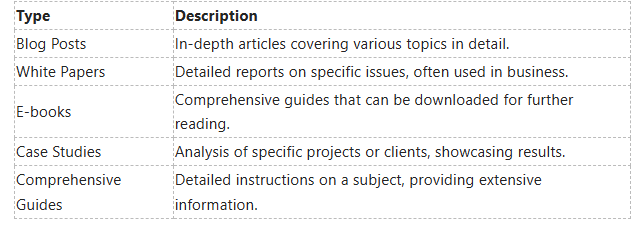
Various formats qualify as long-form content, including in-depth blog posts, white papers, e-books, and comprehensive guides. These formats help you convey detailed information, catering to different learning preferences within your audience. For example, e-books can facilitate deeper learning, while guides provide step-by-step instructions that can be easily referenced.
The applications of long-form content span multiple industries, catering predominantly to those looking for detailed analysis. By offering diverse types of long-form content, you cater to a broader audience and address specific needs that segmented groups might have.
- In-depth analysis to build authority.
- Search engine visibility leading to more traffic.
- Increased engagement time on your site.
- Diverse formats to cater to various preferences.
- Audience loyalty through consistent value.
This categorization of long-form content is vital for strategizing your content marketing efforts. By understanding the various forms, you can tailor your content specifically to address your audience's needs more effectively.
The Rise of Micro-Posts
Definition and Characteristics
Micro-posts are brief, focused pieces of content typically ranging from 50 to 300 words. They are designed to convey a specific message quickly, making them ideal for audiences with shorter attention spans. Key characteristics include brevity, clarity, and a strong call to action, all while ensuring relevance to your audience's interests and needs. These bite-sized pieces are often visually engaging, utilizing images or infographics to enhance their message.
As you craft micro-posts, consider the platform you're using; each social media channel has its unique nuances. For instance, Twitter limits text to 280 characters, while Instagram thrives on visuals paired with succinct captions. This platform-specific tailoring is necessary to maximize engagement and impact.
Significance of Micro-Posts in Digital Marketing
Micro-posts hold significant value in digital marketing by catering to users' increasingly mobile habits and preferences. With 54% of social media users consuming content primarily through mobile devices, quick, shareable content pieces are necessary to capture attention. Micro-posts not only facilitate rapid consumption but also promote shareability across various platforms, driving organic reach.
The ability to engage your audience swiftly is unparalleled; users are more likely to interact with concise content. Additionally, micro-posts can serve to reinforce brand messaging, guiding users back to your long-form content for deeper understanding. This interconnectedness helps maintain brand presence while capitalizing on the strengths of each content type.
Examples of Successful Micro-Posts
Brands like Nike have mastered micro-posting by creating impactful, visually appealing content that resonates with their audience. A single image coupled with a motivating tagline can inspire shares and comments, amplifying their reach significantly. Similarly, BuzzFeed uses humorous quizzes and quick listicles to engage its users, often leading them to longer articles or videos through embedded links.
Consider how Wendy's utilizes Twitter to engage followers with witty, quick-witted replies and concise promotional posts. This strategy not only entertains but enforces brand personality, resulting in increased followers and heightened interaction rates.
These successful examples demonstrate that effective micro-posts can transcend traditional marketing tactics, creating a viral effect that boosts your brand visibility and engagement when executed correctly.
The Importance of Repurposing
Advantages of Repurposing Content
Repurposing content offers significant advantages that can enhance your overall content strategy. By transforming long-form content into micro-posts, you increase the lifespan of your original material, extracting more value from the resources you've invested. For example, a single blog post can be broken down into social media updates, infographics, or email snippets, allowing you to reach your audience across various platforms without starting from scratch.
Additionally, this approach provides an excellent way to reinforce your brand message. You have the opportunity to present core ideas in different contexts, which helps to resonate with diverse audience segments. By strategically repurposing, you can maintain consistency in your messaging while appealing to different preferences, ultimately leading to higher engagement rates.
Time and Resource Efficiency
One of the primary benefits of repurposing content is time and resource efficiency. Developing high-quality content demands significant time and effort, so why not maximize that investment? By repackaging existing content, you can create fresh materials in a fraction of the time it would take to produce something entirely new. This efficiency allows you to focus on other key areas in your business while consistently delivering valuable information to your audience.
Using content that you have already created also reduces the pressure of brainstorming new topics. Leveraging existing content as a foundation offers a springboard for your ideas, enabling you to explore new formats or angles without starting from ground zero. For instance, a well-researched eBook could be segmented into a series of blog posts, each addressing a specific subsection, making it easier to maintain a steady flow of relevant content.
Enhancing SEO and Audience Reach
Repurposing content plays a vital role in enhancing SEO and expanding audience reach. Each piece of micro-content you create provides an additional opportunity for your target audience to discover your brand through various search engines and social media platforms. For instance, a video summary of your long-form article can attract viewers who prefer visual content, while a quote graphic might resonate with those who engage more with quick, digestible posts.
As you optimize each piece of repurposed content with relevant keywords, you effectively build backlinks and increase your site's visibility. This strategy not only improves your search engine ranking but also drives organic traffic, enabling you to connect with potential customers who may not have encountered your original long-form piece. The more formats you utilize, the broader your audience's exposure to your expertise becomes.
Identifying Key Themes in Long-Form Content
Analysis of Core Ideas
To effectively repurpose your long-form content, start by conducting a thorough analysis of the core ideas presented in your original piece. Identify the main arguments and supporting points that resonate most with your audience. For instance, if your long-form article discusses industry trends, pull out specific statistics or case studies that highlight your key points. You might find that a single powerful statistic can easily transform into an engaging micro-post that draws attention on social media.
Utilize tools such as keyword analysis and sentiment analysis to uncover what themes are trending among your audience. By examining the language, emotions, and questions expressed in comments or engagements, you can pinpoint what captures their interest. These insights guide you towards crafting micro-posts that align closely with the foundational messages of your original work, ensuring relevance and resonance.
Segmenting Content for Relevance
Once you have analyzed your core ideas, the next step is segmenting the content into smaller, relevant pieces. Break down the long-form content into sections that can stand alone as valuable insights. For example, if your article includes a how-to guide on a complex topic, consider extracting each step as a separate micro-post. This makes your content more digestible and allows you to reach different audience segments with targeted messages.
Identifying distinct sections within your original content not only simplifies the extraction process but also enhances audience engagement. Each segment can be tailored to address specific pain points or interests, maximizing your content’s impact. Think about using infographics or short videos to represent these segments visually, capturing more attention and facilitating sharing across platforms.
Moreover, segmenting your content allows you to emphasize different aspects of your original message, making it easier to tailor each micro-post to various platforms and audiences. By determining which elements are most likely to resonate, you can enhance your overall content strategy and drive engagement.
Using Audience Insights to Guide Repurposing
Understanding your audience's preferences is necessary when repurposing long-form content. Leverage analytics tools to track engagement metrics and discover which topics or formats resonate most with your readers. By analyzing their comments, shares, and interactions, you can identify the themes they find most compelling. For example, if you notice a spike in shares related to a particular case study or statistic, this can signal an opportunity to create more focused micro-posts based on that interest.
Audience feedback can also provide direction on the best platforms for your micro-posts. If your audience primarily engages on Instagram, consider creating visually appealing graphics or videos that summarize your key insights, while LinkedIn may be more suitable for in-depth article snippets or professional advice. Tailoring your content based on where your audience is most active leads to higher engagement and better overall performance.
Utilizing audience insights not only enhances relevance but also fosters a sense of community among your followers. When you address their interests directly, you create a more engaged audience that feels connected to your content, paving the way for stronger relationships and increased loyalty.
Techniques for Extracting Micro-Post Ideas
Pulling Quotes and Key Insights
One effective way to develop micro-posts is by extracting impactful quotes and key insights from your long-form content. Look for standout statements or thought-provoking ideas that encapsulate the essence of your message. These snippets can be easily transformed into visually appealing graphics or short, engaging text posts that resonate with your audience on platforms like Twitter or Instagram.
Focus on impactful phrases that deliver value in just a few words. For instance, if your long article discusses productivity tips, you might pull a powerful quote about focus or time management. Highlighting these key insights not only encourages shares and saves but also positions you as an expert in your domain.
Creating Lists and Listsicles
Lists and listsicles are a highly engaging format for micro-posts, allowing you to present information in a digestible way. Identify sections of your long content that lend themselves to list creation, such as step-by-step processes or top ten recommendations. This format appeals to readers' preferences for concise, easy-to-scan content.
For example, if your original content includes a plethora of tips, extract them into a numbered list. Posts like “5 Essential Tips for Better Time Management” can catch attention quickly and encourage sharing. Beyond traditional lists, consider creating dynamic lists that vary in style, such as “3 Reasons You Need to Start Journaling” or “7 Must-Have Tools for Content Creation.”
Further, experiment with using engaging visuals alongside your lists to make them even more appealing to your audience. Eye-catching graphics or infographics can reinforce your points while enhancing shareability across various platforms.
Identifying Standalone Sections or Tips
Take a close look at your long-form content and identify sections or tips that can stand alone as valuable micro-posts. These can include actionable advice or brief narratives that convey significant insights without requiring additional context. By isolating these elements, you can create focused content that delivers specific value to your audience.
For instance, if your article includes a detailed section on the benefits of mindfulness, consider breaking it down into isolated tips such as “Practice Mindfulness for 10 Minutes Daily” or “Mindfulness Techniques to Reduce Stress.” This approach ensures that your audience can grasp key concepts quickly, making your posts more likely to be shared.
- standalone tips
- valuable insights
- micro-posts
After compiling these tips, format them clearly and creatively to maximize engagement on social media platforms.
Additionally, curating these standalone insights can also aid in building a cohesive content strategy, enabling you to explore various aspects of a topic over time. Short posts can consistently highlight vital points while driving traffic back to your longer content.
- content strategy
- cohesive themes
- audience engagement
After utilizing these methods, you’ll advance your content marketing efforts, ensuring steady engagement and interest in your long-form pieces.
Formats for Micro-Posts
Text-Based Formats
Text-based micro-posts can effectively convey powerful messages in a concise manner. You can create impactful posts by leveraging strong quotes or one-line insights from your long-form content. For instance, if your long article discusses productivity, pull a thought-provoking statement or statistic about time management and share it as a tweet or a Facebook post. Studies show that posts containing short, digestible sentences often generate higher engagement rates, so keep your language clear and straightforward.
Additionally, text-based formats allow for varying creativity in presentation. Consider using text overlays on images to catch the eye or developing a series of numbered tips that can be easily shared. This format taps into the audience's preference for immediate, actionable advice, enhancing your reach and impact across platforms.
Visual Formats: Images and Infographics
Images and infographics play a pivotal role in transforming lengthy content into visually appealing micro-posts. A visually striking infographic summarizing the findings of your long-form piece can serve as a highly shareable asset on platforms like Pinterest or LinkedIn. Infographics that distill complex data into simple visuals are particularly effective in engaging audiences who might not be inclined to read extensive articles.
Utilize images from your long-form content, such as charts or graphs, to create eye-catching micro-posts. Adding captions or brief descriptions can further enhance understanding and encourage interaction. Always consider the design aspect; ensuring that your visuals align with your brand identity reinforces recognition and trust.
Video Snippets and Reels
Video snippets and reels capitalize on the growing trend of video content consumption across social media. You can extract compelling moments from webinars, interviews, or presentations featured in your long-form content. By editing them into short 15 to 60-second clips, you maintain viewer interest while offering valuable insights. These snippets are highly shareable and can significantly broaden your audience reach.
The importance of captivating visuals in video formats cannot be overstated. Incorporating elements such as subtitles, eye-catching thumbnails, and music will attract viewers, making them more likely to engage and share your content. As video content is often prioritized in platform algorithms, investing time in this format can yield significant dividends in visibility.
Crafting Engaging Micro-Post Content

Writing Compelling Headlines
Headlines serve as the gateway to your micro-posts, and crafting them requires attention to both clarity and intrigue. Aim for brevity—keep your headlines under 60 characters to ensure they are fully visible on most platforms. Use action verbs and power words to catch your audience's eye. For instance, a headline like "Unlock Your Creativity Today!" is more inviting than simply stating "Creativity Tips." You can also incorporate numbers; posts with lists or tips often perform exceptionally well, such as “5 Easy Ways to Boost Engagement."
Consider the value proposition in your headlines. Ask yourself what problem your audience wants to solve. For example, “Master Time Management in 10 Minutes” tells readers exactly what they will gain and how quickly. This clarity will increase your click-through rates and engagement with your micro-posts.
Utilizing Strong Calls to Action
A strong call to action (CTA) is imperative for driving engagement. You want your audience to take specific steps after reading your micro-post, whether that's commenting, sharing, or clicking a link. Phrasing your CTAs like “Join the conversation below!” or “Click here to discover more!” creates a sense of urgency and involvement. Tailor your CTAs to fit the content of your post; ensure they align seamlessly with the message you're conveying.
Moreover, experiment with different types of CTAs. For instance, you might use a question to provoke thought and interaction, such as, “What do you think about this trend?” Active participation helps create a community around your content, enhancing the overall effectiveness of your micro-posts.
Incorporating Multimedia Elements
Visual content significantly enhances the attractiveness of your micro-posts. Posts that include images, infographics, or videos receive up to 94% more views than those that rely solely on text. Choose high-quality visuals that complement your message and make your content more shareable. For instance, using engaging images can increase your post's shareability on platforms like Pinterest or Instagram.
Additionally, consider leveraging tools such as Canva to create custom graphics or videos that encapsulate your ideas succinctly. A brief, animated video summary of your long-form content is likely to catch the attention of busy users who scroll quickly through their feeds.
Utilizing multimedia elements doesn’t have to be labor-intensive. You can repurpose existing visuals from your long-form content, such as using relevant charts or screenshots, making the process efficient while still maintaining quality. Ensure all multimedia elements are optimized for each platform’s requirements to maximize visibility and engagement.
Distribution Channels for Micro-Posts
Social Media Platforms
As far as distributing micro-posts, social media platforms are your best allies. Each platform has a distinct audience and format that influences how your content is received. For example, Twitter’s character limit encourages brevity and wit, making it ideal for sharp insights or catchy quotes from your long-form content. On Instagram, leveraging visually appealing elements like graphics or short videos can enhance your reach, allowing you to share bite-sized information that aligns with your audience's interests.
Platforms like LinkedIn provide a unique environment for professional audiences, where micro-posts can include industry-specific insights that encourage engagement. By repurposing your content based on the platform's characteristics, you increase the chances of resonating with your audience, prompting shares, and building your brand’s presence across various channels.
Email Newsletters
Email newsletters are an excellent medium for delivering micro-posts directly to your audience’s inbox. With an average open rate of around 20%, they allow you to connect personally with subscribers who are already interested in your content. Short, engaging snippets from your long-form pieces, supported by a strong call-to-action, can drive traffic back to your website or blog while keeping your audience informed and engaged.
Utilizing segmentation strategies can further enhance your email marketing success. By customizing micro-posts based on subscriber preferences, interests, or demographics, you ensure that the content is relevant, which can lead to higher engagement and conversion rates over time.
Blogging and Content Aggregation Sites
Utilizing blogging platforms and content aggregation sites effectively allows you to reach broader audiences. Micro-posts can function as teasers for your more in-depth content, effectively driving site traffic by linking back to your original work. Platforms like Medium or subreddits relevant to your niche can expose your repurposed content to highly targeted groups, amplifying your visibility.
Consider formatting your micro-posts as top tips, summaries, or insights that encourage click-through. For instance, a post summarizing five vital takeaways from a larger article can engage readers who may not have the time to read everything but are intrigued by the miniaturized version.
Analyzing Performance Metrics of Micro-Posts
Key Metrics to Track
To effectively gauge the success of your micro-posts, focus on metrics like engagement rate, click-through rate (CTR), and conversion rate. Engagement rate measures interactions such as likes, shares, and comments per post, providing insight into content resonance with your audience. A CTR lets you assess how compelling your micro-posts are at driving traffic to your website or landing pages, while conversion rates indicate how many of those visitors took a desired action, such as signing up for a newsletter or making a purchase.
Additionally, monitor reach to understand your audience size and the potential for your posts. Tracking time spent on the page can offer clues about content quality and the likelihood of persuading visitors to engage further with your brand. Each metric contributes to a broader picture of your content’s performance, guiding your decisions moving forward.
Tools for Measurement and Analytics
Numerous tools can aid in tracking the performance of your micro-posts. Platforms like Google Analytics allow you to analyze traffic patterns and user behavior. Social media dashboards, such as Hootsuite and Buffer, offer insights into post performance and audience engagement levels across various channels. This data is important for understanding what resonates with your audience and can inform future micro-post development.
For more granular analysis, consider using tools like BuzzSumo to monitor content shareability and identify trending topics in your niche. Combining these tools gives you a comprehensive view of how your micro-posts perform, allowing you to adapt your strategy as needed.
Utilizing these measurement tools enables you to aggregate data across multiple channels, enhancing your ability to spot patterns and trends that may not be visible through individual platforms alone. Regularly reviewing this information keeps you attuned to shifts in audience preferences and behaviors, ensuring your content remains relevant and effective.
Adjusting Strategy Based on Insights
Once you’ve gathered performance metrics, the real work begins—adjusting your content strategy accordingly. If certain micro-posts consistently outperform others, consider analyzing their elements, such as format, CTA, or topical focus. For example, if video micro-posts yield higher engagement than text-based posts, you might prioritize video content in your future plans. Continuous experimentation allows you to refine your approach and align better with audience expectations.
Moreover, if you notice a decline in engagement or conversion rates, reassess your content’s relevance and messaging. It may be time to pivot your topics, rethink your audience segments, or experiment with new distribution channels to revitalize performance. Staying adaptable ensures you’re consistently meeting your audience’s needs and maximizing your content's impact.
Best Practices for Efficiency in Repurposing
Establishing a Content Creation Workflow
Creating a streamlined content creation workflow enhances efficiency when repurposing long-form content into micro-posts. Start by outlining your strategy: define your original content pieces and categorize them based on topics, themes, or formats. This structured approach allows you to easily identify which sections can be transformed into micro-posts without losing the core message. Leverage tools like editorial calendars to plan and schedule these micro-posts in advance, ensuring consistent output across platforms.
Next, implement a review process. As you generate micro-posts, establish checkpoints for quality assurance. This may involve pairing with team members to provide feedback on how well your micro-posts convey insights from the original content. By refining your approach over time, you can enhance engagement and optimize performance metrics.
Collaborating with Content Creators
Collaboration can significantly enhance the quality and reach of your repurposed micro-posts. Engage with diverse content creators—whether graphic designers, social media managers, or fellow writers—who can bring their unique skills to elevate your content. Collaboratively brainstorming about the repurposing process can unearth fresh ideas and perspectives that turn static content into dynamic, shareable micro-communications.
To maximize collaboration, consider organizing brainstorming sessions that focus specifically on micro-post opportunities from existing long-form content. You can research into themes, imagery, and catchy phrases that resonate with your audience, making sure that each micro-post feels fresh and inviting while remaining rooted in your primary message.
Utilizing Content Management Tools
Content management tools are necessary in keeping your repurposing efforts organized and efficient. Tools such as Trello, Asana, or Notion allow you to track the lifecycle of your content—from ideation through to publication. By using these platforms, you’ll have a centralized location for all your project details, enabling you to monitor which long-form content has been repurposed and the status of each micro-post.
Moreover, integrating analytics tools can give you insights into how your micro-posts are performing. By examining metrics related to reach, engagement, and conversion rates, you can refine your approach and focus on formats that resonate the most with your audience, ensuring that future repurposing efforts are even more effective.
More info about subsection 'Utilizing Content Management Tools': Establishing a systematic approach through content management tools ensures nothing falls through the cracks. Utilizing features like task assignments, due dates, and reminders helps maintain productivity and collaboration among your team members, driving consistency in voice and branding across all micro-posts. This cohesion builds a recognizable presence in your niche, reinforcing your authority and facilitating stronger connections with your audience.
Overcoming Challenges in Repurposing Content
Maintaining Brand Voice and Consistency
One of the main challenges you face in repurposing content is ensuring your brand voice remains consistent across various formats. Each piece of micro-content should reflect your organization's personality and values, even if the tone or length changes. To achieve this, develop a concise brand voice guide that outlines key aspects of your style, such as language preferences, tone, and messaging pillars. This guide can serve as a reference point whenever you adapt long-form content into micro-posts.
Additionally, analyze your existing content to identify common phrases, themes, and styles that resonate with your audience. By weaving these elements into your micro-posts, you reinforce brand recognition and loyalty, ensuring followers can instantly recognize your content. Utilize examples from successful brands that maintain consistent voice through visual and textual adaptations to inspire your approach.
Avoiding Content Saturation
Overposting can dilute your message and exhaust your audience. To avoid content saturation, establish a strategic posting schedule that balances frequency with quality. Aim to create a content calendar that allows for enough variation between posts while ensuring your messaging stays fresh. Tracking metrics can help you understand how often your audience engages with different types of content and adjust your strategy accordingly.
Segment your micro-posts into different themes or categories derived from your long-form content, spacing them out over time. This method not only avoids overwhelm but also maximizes reach by engaging diverse segments of your audience. Think of it as planning a series rather than bombarding your audience with information all at once.
Consider testing different posting frequencies to determine what resonates best with your audience. For instance, you might find that posting a micro-post derived from long-form content three times a week results in higher engagement than daily posts. Analyze data on how your audience responds to various frequencies to fine-tune your approach.
Ensuring Quality while Scaling
As you repurpose long-form content into micro-posts, maintaining high quality becomes imperative. Quality content encourages engagement and shareability. Implement a review process to ensure each micro-post is polished before publication. Utilize tools such as Grammarly or Hemingway to enhance readability and clarity, ensuring that your messages are refined and resonate with your target audience.
Additionally, consider creating templates for your micro-posts. This saves time while allowing for consistency in design and messaging. Each template can incorporate branding elements that align with your long-form content, thus maintaining a cohesive look and feel. When scaling your efforts, ask for feedback from your audience to continuously improve.
A systematic approach to quality control can involve creating a checklist for your micro-posts, assessing elements such as relevance, alignment with brand voice, and overall clarity. Regularly evaluate the performance of your posts to identify areas for improvement and adjust your strategies accordingly.
Case Studies of Successful Repurposing

- Buffer: Transformed a 5,000-word guide on social media strategy into 15 engaging micro-posts, driving a 200% increase in social engagement.
- HubSpot: Repurposed their extensive blog content into short video snippets, resulting in a 150% boost in video views across platforms.
- Neil Patel: Converted a comprehensive podcast episode into a series of infographics, which increased his website traffic by 120% within a month.
- Canva: Took lengthy tutorials and created bite-sized posts for Instagram Stories, leading to a 300% rise in follower interactions.
- Content Marketing Institute: Distilled a detailed report into a slide deck shared on LinkedIn, achieving a 250% uplift in shareability and audience reach.
Brand Examples
Your approach can greatly benefit from studying brands like Buffer and HubSpot. By breaking down extensive guides and tutorials into manageable posts, they have significantly increased engagement rates on social platforms. For instance, Buffer's initiative to break a lengthy guide into 15 smaller posts resulted in a pronounced upturn in social engagement metrics.
Another standout example is Neil Patel, who effectively repurposed a podcast episode into infographics. These visual representations not only attracted readers but also heightened his overall website traffic, demonstrating how visual content can amplify reach and engagement.
Lessons Learned and Strategies Employed
Your content repurposing strategy can benefit from key insights gained by brands. Focusing on audience preferences is vital; understanding which formats resonate most can guide your decisions effectively. Adapting long-form content into digestible segments, like quotes or infographics, enhances engagement as users favor easily sharable content.
Additionally, employing multiple formats—like videos, infographics, or social posts—can broaden your audience. Using data analytics to continuously assess which formats yield the best results helps refine your ongoing strategy, ensuring you optimize future content.
This multilayered approach, focusing on diverse content types tailored to audience preferences, is necessary for effective repurposing. As you adopt these strategies, consistently evaluate performance metrics to fine-tune your methods over time.
Metrics of Success
To truly assess the impact of your repurposed content, you need to look at key metrics such as engagement rates, shares, and audience reach. By tracking these indicators, you can gain insights into what resonates with your audience. For example, following the repurposing of long-form articles into micro-content, brands have noted increases in engagement by as much as 300%, indicating strong performance.
Another metric to consider is the traffic growth to your main content hubs. High-quality micro-posts can serve as gateways that channel users back to your website or primary content, bolstering overall traffic and paving the way for greater conversions.
By consistently monitoring these metrics, you can identify which aspects of your repurposing strategy yield the highest returns. Regular analysis will empower you to pivot when necessary, ensuring your content strategy evolves alongside audience needs.
Future Trends in Content Repurposing
Evolving Content Consumption Habits
Your audience’s content consumption habits are shifting rapidly. With the rise of mobile devices and shorter attention spans, people increasingly prefer bite-sized, easily digestible content. In fact, studies show that nearly 80% of consumers are more likely to engage with content that’s brief and straightforward. As you repurpose your long-form content, focus on distilling it into concise, impactful messages that align with these evolving habits. The more engaging your micro-posts are, the better your chances of capturing attention in a crowded digital landscape.
Moreover, the integration of video content has become a game changer. Platforms like TikTok and Instagram Reels illustrate that your audience favors not only shorter content but also more visual formats. Adapting your long-form articles into short videos or animated infographics can significantly boost engagement, allowing you to tap into this visual-centric consumption trend effectively.
Technological Innovations Impacting Repurposing
Emerging technologies are revolutionizing how you can repurpose content. Automation tools and AI-driven platforms can analyze your long-form content and suggest the most engaging snippets to convert into micro-posts. For instance, tools like Canva or Lumen5 allow you to create compelling visuals from your text, streamlining the process of adapting your content for different formats and platforms.
Additionally, AI content generators like Jasper provide enhanced capabilities, enabling you to create tailored summaries, social media posts, or even entirely new pieces based on your original content. These innovations can significantly reduce the time and effort involved, allowing you to focus on strategy and creativity rather than manually editing and repurposing each piece.
Predictions for Content Marketing Strategies
Furthermore, personalized content delivery will dominate the landscape. As algorithms become increasingly sophisticated, you’ll need to utilize your long-form content to create personalized micro-posts that cater to individual audience segments. This level of customization is set to become necessary for maintaining relevance and maximizing engagement.
To wrap up
The ability to repurpose long-form content into micro-posts allows you to maximize your content’s reach and engagement. By distilling your comprehensive ideas into bite-sized pieces, you cater to the preferences of your audience who favor quick, digestible information. This strategy not only increases visibility but also reinforces your key messages across various platforms, ensuring that your core content resonates with a broader audience.
As you implement these repurposing techniques, focus on extracting the most valuable insights from your long-form pieces. By creating attention-grabbing headlines and utilizing visuals, you can transform in-depth analysis into engaging micro-posts that spark interest. This approach saves you time while maintaining your content's integrity, allowing you to establish authority in your field effectively.
FAQ
Q: What is long-form content?
A: Long-form content refers to in-depth articles, blog posts, or videos that typically exceed 1,000 words. It provides comprehensive information on a particular topic, engaging readers and establishing authority.
Q: How can I identify key points from long-form content for micro-posts?
A: Key points can be identified by reviewing headings, subheadings, and highlighted text within the long-form content. Look for statistics, quotes, or actionable insights that can be summarized into concise statements.
Q: What platforms are best for sharing micro-posts derived from long-form content?
A: Ideal platforms for sharing micro-posts include social media channels like Twitter, Instagram, and LinkedIn. Each platform supports brief content that can drive traffic to the original long-form piece.
Q: How can visuals enhance micro-posts created from long-form content?
A: Visuals, such as infographics, images, or short videos, can significantly boost engagement. They capture attention, making the micro-posts more shareable and helping convey the message quickly.
Q: What type of call-to-action should I include in my micro-posts?
A: Effective calls-to-action in micro-posts could encourage readers to visit the full article, engage with questions, or share their thoughts. Phrasing examples include "Read more," "Share your opinion," or "Discover the complete guide."
This is paragraph text. Click it or hit the Manage Text button to change the font, color, size, format, and more. To set up site-wide paragraph and title styles, go to Site Theme.