
The psychology behind the typical online consumer journey
You move through predictable stages-awareness, evaluation, conversion-guided by attention, emotion, and cognitive bias; clear trust signals boost conversions, while dark patterns and urgency cues exploit biases.
Key Takeaways:
- Awareness stage: Attention is driven by emotion and relevance; visual cues and concise messaging determine whether a visitor engages further.
- Social proof and trust signals: Reviews, ratings, and recognizable badges reduce perceived risk and speed progression from consideration to purchase.
- Decision heuristics: Shoppers rely on shortcuts like scarcity, price anchoring, and default options to simplify choices when cognitive load is high.
- Friction and conversion: Excess steps, slow load times, or unclear CTAs increase drop-off; simplified flows and clear value propositions lower abandonment.
- Post-purchase behavior: Confirmation, easy returns, and timely follow-ups turn one-time buyers into repeat customers by reinforcing satisfaction and habit.
The Pre-Purchase Phase: Triggering the Digital Need
Online signals in search results, notifications, and social feeds prime you to notice products, turning fleeting attention into desire; impulse triggers can boost clicks while creating privacy risks if tracking is opaque.
Internal vs. External Stimuli in the Online Environment
Signals from within-hunger, boredom, aspiration-combine with external nudges like targeted ads and friend recommendations to prompt you toward action, so mapping internal drives against external cues improves prediction of who will convert.
The Science of Priming and Latent Demand Recognition
Priming uses subtle exposures-a color, a phrase, a prior ad-to shift your attention and bring latent demand forward, increasing the likelihood you will search or click when a matching offer appears.
Research indicates that timing and context matter: brief, relevant primes yield measurable choice changes, producing notable conversion lifts while posing clear ethical concerns about manipulation.
Neuromarketing ties priming to associative memory networks so when you encounter related cues your latent preferences activate and you act as if the desire is new, which means you should validate campaigns with controlled tests to spot potential subliminal risks.
Information Search: Cognitive Biases and Mental Shortcuts
Search in this stage relies on fast heuristics, so you skim star ratings, brand cues and price flashes to cut cognitive load; this makes you favor signals that feel trustworthy over exhaustive comparison, and it can lead to systematic blind spots when you ignore underlying product fit.
Social Proof and the Bandwagon Effect in User Reviews
You interpret large volumes of positive feedback as a safety signal, which increases your likelihood to buy and reduces skepticism; prominent review counts and averages act as a mental shortcut. Seeing many five-star reviews often convinces you before you inspect specifics.
The Anchoring Effect in Comparative Pricing Models
Anchors establish the first numeric reference you use, so you assess subsequent prices relative to that initial figure and often overvalue perceived discounts. Visual contrasts like a crossed-out price next to a sale price push you toward purchases by creating illusory savings.
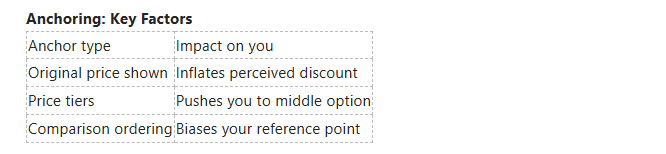
Consider that layout, timing and the presence of a high anchor can be subtle levers; you often miss better-value alternatives when an early anchor reshapes your internal scale.
Authority Bias and the Influence of Expert Endorsements
Experts and certifications shortcut your evaluation because you assume competence; a trusted endorsement increases your confidence and reduces the need for independent checks. Prominent seals and recognizable names function as powerful trust signals that speed decision-making.
Imagine that an authoritative recommendation can outweigh mixed user reviews for you, causing you to prioritize expert opinion and sometimes dismiss conflicting consumer feedback.
The Evaluation of alternatives: navigating choice overload
Hick’s Law and the Paradox of Choice in E-commerce
Hick’s Law shows that as options rise, the time you take to decide increases exponentially; in e-commerce this drives higher abandonment rates when product lists overwhelm shoppers. You should present curated sets and progressive disclosure so you can compare fewer meaningful options and complete purchases more quickly.
The Psychology of Filtering and Mitigating Decision Fatigue
Filters help you narrow options quickly; well-designed facets let you focus on relevant attributes and avoid decision fatigue that triggers cart abandonment. You benefit from clear labels and minimal choices per filter to keep mental effort low.
You respond to smart defaults, saved preferences, and stepwise refinement, which reduce cognitive load and produce measurable conversion lift. Testing preset combinations reveals what simplifies choices without stripping necessary variety.
Algorithmic suggestions can surface matches based on your past behavior, but you should monitor for bias and provide transparent controls so recommendations feel trustworthy rather than manipulative.
The moment of conversion: overcoming transactional friction
Conversion is where you must remove barriers that interrupt decision momentum; reducing form fields, clarifying total cost, and displaying secure payment signals turns hesitation into action and lowers abandonment.
Loss Aversion and the Application of the Scarcity Principle
Scarcity taps into loss aversion, pushing you to act when stock or time appears limited; using authentic, measurable scarcity boosts urgency, while artificial scarcity can erode trust and increase churn.
Reducing Cognitive Load in the Checkout User Experience
Simplifying the checkout by prioritizing imperative fields, offering autofill, and showing a clear progress indicator helps you finish faster and reduces error-driven drop-offs, directly improving conversion rates.
Test default choices, inline validation, and concise microcopy so you encounter fewer decisions and lower mental effort; this clarity decreases friction and increases completed purchases.
The Dopamine Response to Purchase Completion and Gratification
Completion triggers a dopamine spike that reinforces buying behavior, so you should amplify positive feedback-order confirmations, clear next steps, and celebratory visuals-to encourage repeat purchases.
Trigger immediate rewards like shipment updates, loyalty points, or follow-up offers to extend gratification and create positive reinforcement that makes future conversions more likely.
Post-purchase behavior: managing dissonance and loyalty
Mitigating Buyer’s Remorse through Cognitive Alignment
When you experience post-purchase doubt, immediate clear communication reduces buyer’s remorse. You should restate the purchase rationale, share setup tips, and offer easy returns and visible support to realign cognition and preserve trust.
The Formation of Habit Loops and Brand Advocacy

Repetition of small rewards and low-friction cues turns one-off purchases into routines; you form associations that make your brand the default choice. Positive experiences paired with frictionless repurchase cues and timely rewards create habit loops that breed advocacy.
Rewards that match user values increase repetition, but if incentives feel manipulative you risk transactional loyalty rather than true advocacy. You should balance discounts with community, recognition, and functional value to sustain long-term brand champions.
Consistency in triggers and simple actions cements the cue-routine-reward cycle; you can design onboarding emails, reorder shortcuts, and subscription nudges as triggers that reduce decision friction. Long-term advocacy emerges when those loops deliver reliable value instead of coerced purchases, so measure retention signals rather than one-off conversion spikes.
The Role of Personalization in Consumer Identity
You treat personalized experiences as signals about how a brand sees you, which reshapes expectations and choice momentum; matching those signals to your self-concept increases trust but can also raise privacy concerns if data feels overused.
Self-Congruity Theory and Targeted Product Relevance
Your choices gravitate toward products that reflect your identity, reducing internal conflict and enhancing perceived fit; this alignment drives higher conversion rates and deeper loyalty.
Matching visuals and messaging to your social identity makes you more receptive to offers, while misaligned cues provoke rejection; brands that achieve congruence report measurable gains in retention.
The Reciprocity Principle in Digital Relationship Building
When a platform offers you genuinely useful free value-guides, trials, or tailored recommendations-you feel inclined to reciprocate, and small timely incentives often produce increased engagement.
If you detect manipulative tactics or hidden tracking, your willingness to reciprocate collapses, and that privacy risk can erase hard-won trust.
Seeing prompt, personalized responses to your behavior-custom replies, targeted discounts, or relevant follow-ups-reinforces reciprocal behavior and turns casual interest into repeat purchases and long-term value.
Summing up
So you learn that attention, trust cues, scarcity and confirmation biases guide browsing decisions; recognizing emotional triggers and reducing decision friction lets you craft persuasive content, optimize micro-interactions, and improve conversion while respecting user autonomy.
FAQ
Q: What psychological stages do consumers pass through during a typical online purchase journey?
A: Most consumers move through awareness, interest, consideration, intent, purchase, and post-purchase stages. Attention and perception determine whether a message breaks through, working memory and cognitive load shape how much information a shopper can process, and heuristics such as familiarity and price anchors speed decision-making. Trust cues and social proof convert intent into action, while post-purchase experiences and expectation confirmation influence repeat behavior and word-of-mouth.
Q: How does attention and perception shape the early discovery phase online?
A: Visual salience, clear value propositions, and personal relevance control initial attention. Short-term memory limits mean brief, focused messages and strong cues like headlines or thumbnails outperform dense content. Contextual targeting and timing increase perceived relevance, and repeated exposure builds familiarity that lowers perceived risk and raises likelihood of further engagement.
Q: What role do emotions and persuasion tactics play in moving consumers from consideration to purchase?
A: Emotions act as shortcuts that bias choices; positive affect boosts purchase likelihood while fear of missing out creates urgency. Persuasion tactics such as scarcity, social proof, authority signals, and reciprocity shape perceived benefits and costs. Cognitive biases like anchoring and loss aversion adjust value perception, so framing price and benefits strategically increases conversion.
Q: How do trust, social proof, and credibility influence conversion rates?
A: Trust reduces perceived risk and increases willingness to transact. User reviews, ratings, testimonials, and recognizable trust badges serve as credibility signals that reduce uncertainty. Transparent policies, easy returns, and visible contact options lower anxiety and counteract negative information, while mixed or fake-looking reviews can sharply undermine conversion.
Q: Which psychological factors determine post-purchase satisfaction and repeat buying?
A: Expectation management and confirmation drive satisfaction; outcomes that meet or exceed expectations produce loyalty and advocacy. Cognitive dissonance after purchase can be reduced with reassuring communication and social validation. Habit formation, timely onboarding, personalized follow-ups, and relevant incentives increase retention, while friction in fulfillment or support erodes trust and discourages repeat purchases.
This is paragraph text. Click it or hit the Manage Text button to change the font, color, size, format, and more. To set up site-wide paragraph and title styles, go to Site Theme.